


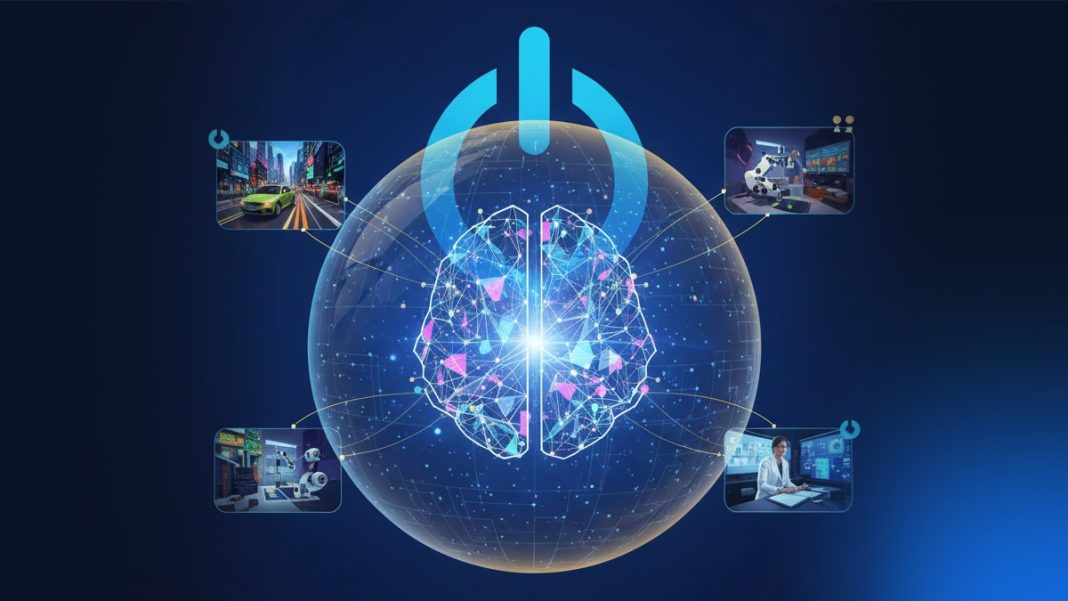
Although AI has been developing at an absurdly rapid pace recently, many experts believe that larger language models or more advanced image generators won’t be the next big breakthrough. Rather, they are placing a wager on “world models.” And truthfully? Most people don’t realize how important this could be.
Even so, what are world models?
Consider how you deal with reality. You don’t merely respond to the events that are directly in front of you. You envision situations, forecast potential outcomes, comprehend cause and effect, and make plans in advance. You don’t have to physically enter traffic to know what would happen before crossing a street; instead, you can mentally model it and conclude, “Yeah, that’s a terrible idea.”
World models are essentially attempting to give AI that. AI with world models would create internal representations of how reality functions rather than merely being extremely complex pattern-matching systems. They would be able to forecast future occurrences, model outcomes, and develop a true comprehension of cause and effect as opposed to merely statistical correlations.
The Issue With Present AI (That Not Enough People Discuss)
The problem with today’s AI systems is that while they are remarkably good at certain tasks, they are also fundamentally limited in ways that aren’t immediately apparent. They work with large datasets as pattern matchers. If you give them enough examples, they can produce incredible writing, analysis, and images, among other things.
However, alter the circumstances slightly, expose them to uncertain situations, or ask them to use reasoning about physical reality that they haven’t been specifically taught? They have difficulty. Hard. Since they only identify patterns in their training data, they don’t truly comprehend the world.
For many uses, that is acceptable. However, it’s also the reason we keep encountering instances where AI performs an incredibly intelligent task and then immediately follows it up with an absurdly foolish one. Simply put, there is no understanding.
The Real Potential of World Models
Things would quickly become interesting if AI systems could create realistic world models. Consider robotics as a clear illustration. Robots currently learn by making a lot of mistakes. They experiment, keep failing, and eventually figure out what works. It is ineffective and slow.
A robot could use world models to internally model various strategies before attempting them out in real life. Without actually fumbling around breaking things first, it could mentally test “what happens if I grip this object here versus there” and choose the best option. Suddenly, instead of only operating in controlled lab settings, you have robots that can learn more quickly, perform more consistently, and even operate in untidy real-world settings like homes or hospitals.
However, the ramifications extend far beyond robots running into furniture. Because self-driving cars would simulate human driving behavior rather than merely responding to sensor data, they could be able to predict road behavior more accurately. Medical AI may be able to model the course of a disease over time, giving doctors more insight into treatment planning. Instead of merely examining past trends, financial systems could test strategies by simulating market behavior.
The largest possible change? improved decision-making in situations that are unclear and chaotic, which essentially characterizes real life. Individuals make surprising decisions. The surroundings shift. Little things lead to big things. Instead of simply folding when conditions don’t match their training data, AI with robust world models could manage that complexity.
The Road to (Perhaps) General Intelligence
AI today is strangely limited. Although GPT-4 excels at language, it is incapable of reasoning about tangible objects. Although image models produce beautiful images, they lack the intuitive understanding of spatial relationships that humans possess. Every system performs exceptionally well in its particular field and is essentially worthless outside of it.
Global models could aid in closing that disparity. AI systems could more successfully transfer
knowledge between domains if they gain a true understanding of how the world behaves, including physics, causality, and temporal dynamics. If a simulation-trained AI has solid world models rather than merely memorized patterns, it may be able to adapt to real-world situations.
That brings us one step closer to general intelligence. Rather than being extremely specialized tools, these systems are capable of broad reasoning in a variety of contexts—not human-level consciousness or anything that dramatic.
How Scientists Are Actually Constructing This
Although the technical methods differ, the majority combine massive neural networks, reinforcement learning, simulation environments, and machine learning. In order to train systems, some teams allow them to interact with simulated environments and gain experience. Others provide AI with vast amounts of video data, enabling it to observe reality and learn how things move, how events develop over time, and how physics truly operates.
Although it’s incredibly computationally expensive, the work is truly fascinating. Since you’re basically attempting to encode how reality functions, which is—you know—pretty complex, building detailed world models requires a significant amount of training resources.
The Difficulties No One Wants to Discuss This is where things get complicated. Your AI will make terrible decisions and inaccurate predictions if your world model is even slightly off. Unlike text generation, you can’t simply regenerate if the output doesn’t seem right. Making incorrect predictions could be extremely dangerous in robotics or autonomous vehicles.
The computational cost comes next. It takes a tremendous amount of resources to simulate the world in sufficient detail for practical applications. The majority of organizations just cannot afford the training requirements we are discussing.
And then there are ethical issues because there is always a “and then” when it comes to powerful AI. Artificial intelligence (AI) capable of precisely forecasting behavior and mimicking human actions may allow for privacy violations, manipulation, and surveillance. Strong enough to be truly beneficial, world models are also strong enough to be gravely abused.
Why Despite the Difficulties, This Is Still Important
Look, not all problems can be solved by world models. They won’t produce AGI by magic the following year, despite what tech guys are saying on Twitter. However, they offer a genuinely significant path toward expanding AI capabilities beyond “bigger models trained on more data.”
If successful—and that’s still a big “if”—world models could lead to safer autonomous systems, more intelligent robots, more dependable AI assistants, and applications that we haven’t even thought of yet because of the limitations of current AI.
The Real Revolution (If It Occurs)
Moving AI from impressive outputs to actual understanding is the fundamental shift that world models represent. Existing systems are very good at making pattern-based predictions. Reasoning based on how reality functions would be a strong suit for world model AI.
That’s the distinction between an AI that can produce convincing physics text and an AI that actually comprehends physical principles and can use them in new contexts. between image recognition systems and systems that comprehend causal dynamics and spatial relationships.
We may witness a new wave of capabilities where AI not only reacts to inputs but also plans, predicts, and acts with something like deeper intelligence if it can learn to model the world in a way that is even partially similar to that of humans.
Will the world models live up to the expectations? Hard to say. There is a long history of promising advances in AI research that either take much longer than anticipated or prove to be less revolutionary than anticipated. However, the basic idea makes sense, the research path appears promising, and the possible uses are genuinely fascinating.
World models are still primarily used in experimental systems and research labs. We’ll find out over the coming years whether they serve as the basis for next-generation AI or are just another intriguing strategy that doesn’t work out. In any case, it is unquestionably important.