

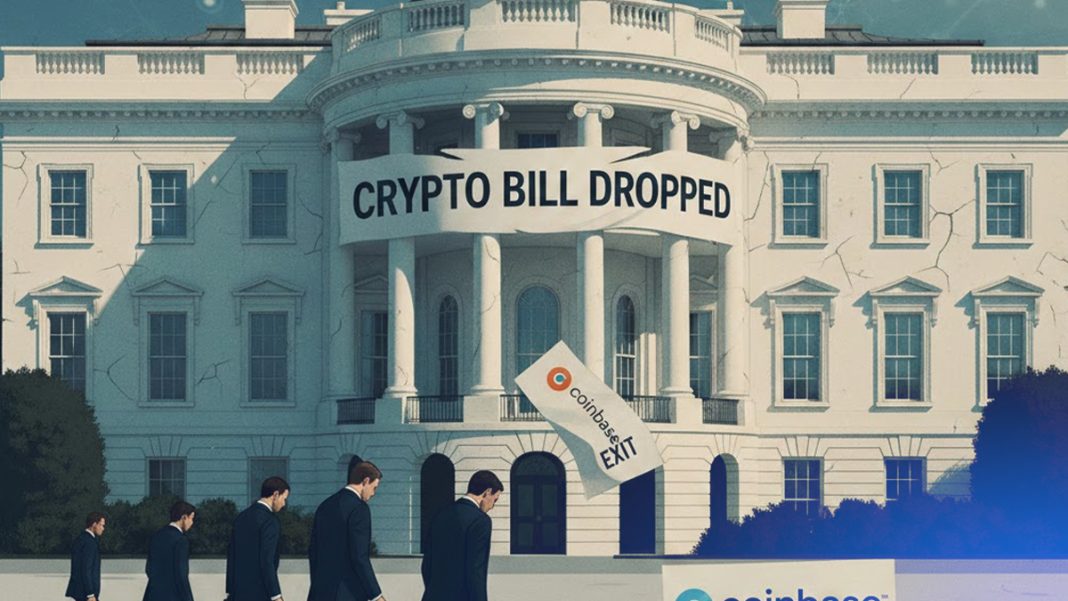
Things just got messy for that major crypto bill working its way through Congress. Word is the White House might be backing away from supporting it, and timing-wise, this comes right after Coinbase publicly pulled out. For an industry desperately hoping for clearer rules and some policy stability, this is turning into a real headache. When the biggest crypto exchange in America takes such a hard stance against something, you have to wonder if the whole thing’s about to collapse.
Coinbase didn’t just quietly withdraw support—they came out swinging. The company basically accused traditional banks of twisting lawmakers’ arms to rewrite the legislation in ways that favor legacy financial institutions while screwing over crypto businesses. According to Coinbase, the bill’s been modified to slap unfair restrictions on crypto companies while handing more power and advantages to the banking establishment. That’s a pretty serious accusation, and it’s thrown gasoline on discussions that were already heated in Washington.
Now the White House is apparently having second thoughts. Government officials have been trying to bring some order and oversight to crypto for a while, but the political reality here is complicated. When a major player like Coinbase walks away, any bill becomes way harder to push through—both politically and in terms of public perception. Without buy-in from actual crypto companies, lawmakers risk getting hammered with criticism that they’re not trying to enable innovation but rather strangle it.
Crypto regulation has been this ongoing battle in the U.S. for years now. One camp of lawmakers wants stricter oversight because of all the disasters we’ve seen—market crashes, bankruptcies, exchange hacks, fraud that’s wiped out regular investors. Their argument is pretty straightforward: tighter rules protect consumers, stop criminal activity, and keep the financial system stable. Makes sense on paper.
The other side—mostly crypto firms and their supporters—keeps warning that unclear or heavy-handed regulation will just push innovation offshore. They argue that if the U.S. makes things too difficult, blockchain startups and investment capital will relocate to countries with friendlier policies. And honestly, there’s some truth to that concern.
Initially, this bill looked like it might actually bring some clarity. People were cautiously optimistic that it would establish real guidelines for how crypto exchanges, stablecoins, and digital assets should operate. Clear laws help businesses plan, build products with confidence, and understand what compliance actually looks like. But as negotiations dragged on, worries started emerging that the bill had shifted toward restrictive controls that could choke growth across the entire crypto ecosystem.
Coinbase’s criticism also shines a spotlight on banking lobbyists and what they’re up to behind the scenes. The company’s claiming that traditional banks have every incentive to slow crypto’s expansion—and look, they’re probably not wrong. Blockchain-based payments, DeFi products, crypto exchanges—all of this directly challenges how banks have operated forever. Crypto platforms let users move money faster, trade internationally, access financial services without depending entirely on banks. That threatens banking fees and disrupts revenue models that have been around for decades. Of course banks see crypto as a competitive threat.
If the White House actually walks away from this bill, we’re looking at a significant pause in U.S. crypto legislation. That could mean more uncertainty for businesses and investors trying to figure out what’s allowed and what isn’t. Most companies want clear rules—they just want regulations that still permit growth, competition, and innovation. If the bill gets scrapped entirely, the U.S. might keep relying on this patchwork of enforcement actions and case-by-case decisions instead of building an actual coherent framework.
That said, some people in crypto might actually see the White House stepping back as a good thing. Maybe the bill needed major improvements before becoming law. From that perspective, it’s better to hit pause than rush through legislation that could damage the industry or hand traditional finance too much control. A delay might give lawmakers time to draft new versions that balance consumer protection with supporting innovation.
Markets could react pretty strongly to this kind of uncertainty too. Crypto investors tend to be hypersensitive to U.S. policy news because regulations directly impact exchange operations, how stablecoins function, tax obligations, and whether institutional investors feel comfortable getting involved. If the bill stalls or dies, some investors will worry about continued instability. Others might actually feel relieved that strict new rules won’t land immediately.
This whole situation really captures the ongoing power struggle between crypto companies, regulators, and traditional banks over who gets to shape finance’s future. The next few weeks matter a lot as lawmakers figure out whether to revise the bill, introduce completely new proposals, or restart negotiations in ways that might restore industry confidence.
For now, crypto businesses and investors are stuck watching and waiting, knowing that whatever the U.S. decides won’t just affect American markets—it’ll influence the direction of digital finance globally. When the world’s largest economy makes moves on crypto policy, everyone pays attention.
The frustrating part is that almost everyone agrees some level of regulation makes sense. The question has always been what kind of regulation. Rules that protect consumers while enabling innovation? Or rules that protect incumbent financial institutions while limiting competition?
Coinbase clearly thinks this bill tilted too far in one direction. Whether they’re right, or whether they’re just upset about not getting their preferred version, probably depends on who you ask. But their exit, combined with White House hesitation, suggests this particular attempt at crypto legislation might be dead in the water.
What comes next is anybody’s guess. Maybe they’ll redraft something more balanced. Maybe crypto regulation gets kicked down the road again. Maybe we end up with something even more restrictive. The only certainty right now is uncertainty—which, ironically, is exactly what this bill was supposed to fix in the first place.