

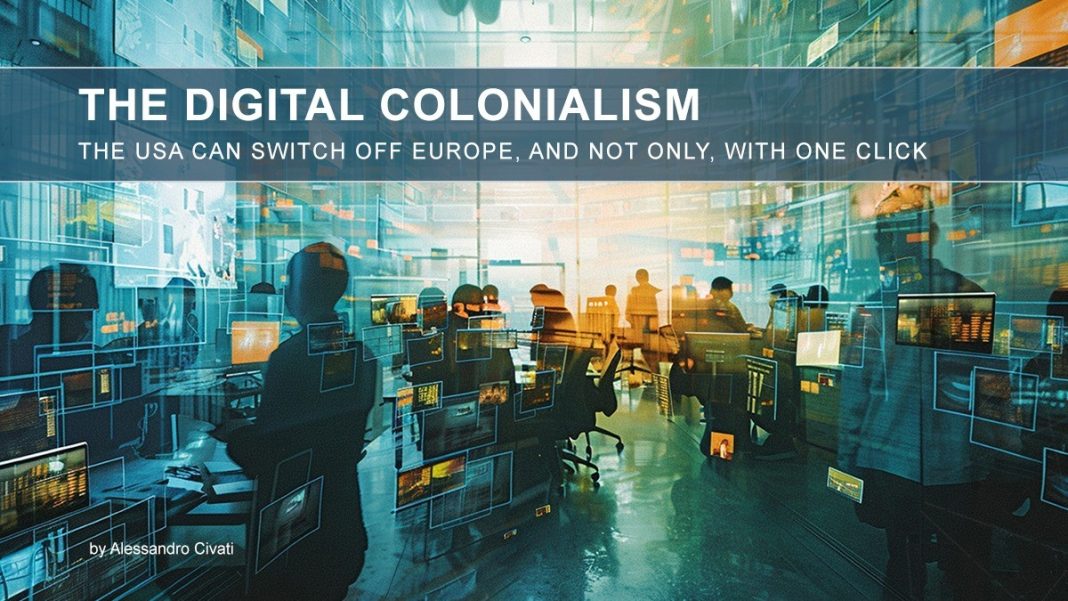
Imagine a political crisis unfolding in Washington, a tense phone call in the Situation Room, and, in a US data center, a “soft” decision is made to suspend services to specific regions “for security and compliance reasons.” In just seconds, ministries across Europe and Africa lose access to their systems, banks are unable to process payments, airlines cannot board passengers, and hospitals can’t access records. This isn’t due to a cyberattack, but because foreign-owned platforms and cloud services have been turned off.
This isn’t a dystopian script; it’s the inevitable result of much of Europe, Africa, and the Global South relying on a few US companies for their digital infrastructure.
TWO REAL-WORLD SWITCHES THAT ALREADY FLIPPED
In September, Microsoft restricted access to certain Azure cloud and AI services for Israel’s elite cyber-intelligence group, Unit 8200, following investigations that showed the unit was utilizing Microsoft infrastructure for mass surveillance of Palestinians, breaching the company’s policy. No UN sanctions, no G7 summit. A private US company, facing public pressure from the US and EU, unilaterally limited a sovereign state’s intelligence capabilities by altering a cloud configuration.
In early December, the European Commission imposed a €120 million fine on X (formerly Twitter) for distributing “deceptive” blue checkmarks, failing to provide ad transparency, and limiting researchers’ access to public data. This was the first major enforcement action under the Digital Services Act. X responded by deactivating the Commission’s advertising account—a symbolic move that clearly shows power: a private US platform can control how, and if, European institutions participate in one of the key spaces of public debate.
Combining these two facts makes it clear: if US platforms and clouds can limit an Israeli spy unit or Europe’s institutional voices, they have the power to restrict anyone.
OUTAGES ALREADY SHOW US THE MOVIE
We’ve already seen a glimpse of what “one click” looks like, by mistake. On December 5, 2025, Cloudflare experienced a significant outage: from 08:47 to 09:12 UTC, approximately 25 minutes of widespread disruption caused “500 Internal Server Error” messages across large parts of the internet. This affected services such as LinkedIn, Zoom, Canva, Indian stock-trading platforms, gaming, and payment services. The cause was not a complex nation-state attack but rather a misconfiguration during a patching process for a React Server Components vulnerability. For those 25 minutes, parts of Europe, India, and other regions experienced exactly what a politically motivated shutdown might feel like: platforms unreachable, orders stuck, customer service down, all because a US-based infrastructure provider sneezed.
Now consider the same effect but applied deliberately and with specific targeting.
NOT JUST EUROPE: A NEW DIGITLA COLONIALISM
The problems pointed out in Europe are even more serious in much of Africa and the Global South. Across the continent, governments, banks, telecom companies, and startups are quickly shifting to AWS, Microsoft Azure, and Google Cloud to improve their scale and speed.
At the same time:
- Africa hosts less than 1% of global data center capacity.
- Foreign companies control between 95% and 97% of submarine cable capacity landing on African shores.
Researchers are increasingly calling this phenomenon “digital colonialism”: it involves offshore control of infrastructure, platforms, and data extraction, which leaves local economies dependent on infrastructure they neither own nor govern. For many African countries, a large portion of essential data, including tax records, health information, and payment systems, is stored on infrastructure managed by companies based in Seattle or Silicon Valley. This means it is ultimately subject to US jurisdiction, export controls, and sanctions regimes.
A geopolitical crisis, a wave of sanctions, or a unilateral corporate “ethical decision,” like Microsoft’s action regarding Unit 8200, could potentially leave these countries stranded in the digital world overnight.
SOVEREIGNTY PLANS: FROM BRUSSELS TO NAIROBI
Europe has at least begun to acknowledge the issue. Projects such as Gaia-X seek to create a federated and secure data infrastructure governed by European laws, emphasizing data sovereignty and interoperability rather than relying solely on hyperscalers. The EU Cloud Sovereignty Framework, published in October 2025, seeks to implement specific sovereignty objectives aligned with NIS2, DORA, and other regulations for all cloud services procured by EU institutions.
My analysis emphasizes a stronger point: sovereignty cannot be achieved solely through contracts and regulations; it requires control over the entire technological infrastructure. A truly resilient Europe would need to develop its own hardware, operating systems, hypervisors, and cloud platforms—essentially a comprehensive industrial strategy that goes beyond simple compliance labels.
African countries are gradually aligning their policies, with South Africa’s 2024 National Policy on Data and Cloud explicitly linking cloud adoption to data sovereignty and local infrastructure requirements. While other nations are developing data localization and cloud regulations, these policies remain in early stages and are often overshadowed by the economic appeal of affordable foreign cloud services.
U.S. SECURITY LAW GRANTS ACCESS TO EVERY DATA
There is a second layer to this dependence: US security and surveillance law.
The CLOUD Act allows US authorities to require US-based providers— and even foreign providers with a significant US presence— to provide data, no matter where it’s stored. This includes data stored in EU or African data centers managed by US companies.
FISA Section 702 authorizes the targeted collection of foreign intelligence from non-US persons abroad, requiring the cooperation of electronic communication and cloud service providers. Orders are issued by the secret Foreign Intelligence Surveillance Court and mostly happen behind closed doors.
Moreover, National Security Letters and similar tools include gag orders that prevent companies from informing users about data requests — sometimes even stopping them from disclose receiving any order.
In practice, US agencies can secretly request extensive access to data stored by providers under US jurisdiction for reasons like “national security” or serious crime, protected by legal secrecy. For Europeans, Africans, or any foreign users on US clouds, this constitutes a hidden back door into their most sensitive information.
One click, many futures
The key lesson from Europe, Africa, and other regions is painfully clear:
- Whoever manages your cloud infrastructure holds the key to your ongoing continuity.
- Dependencies created for convenience today can become strategic weaknesses in the future.
- Digital sovereignty has become essential, now regarded as the new form of energy security.
Governments, regulators, and boards in Brussels and Nairobi face a decision not about whether to adopt US technology, but whether to stay switchable or to collaborate on building regional infrastructures that are resilient enough to prevent a single foreign actor from shutting down an entire economy with a single click.
Author: Alessandro Civati. – Zug (Switzerland), Dec 8, 2025
👉 👉 👉 Intellectual Property protected using LutinX Blockchain – Check the IP registration.