

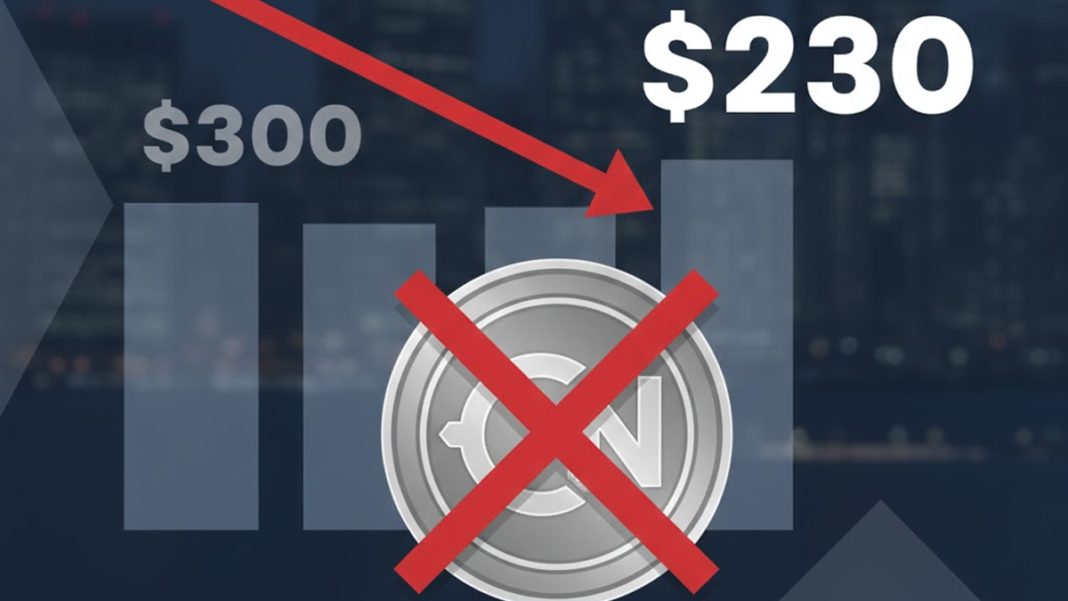
Needham & Company trimmed its price target on Coinbase (NASDAQ: COIN) from $290 to $230 Friday while holding onto its Buy rating, citing persistent trading weakness that’s expected to drag into the first quarter of 2026. Despite the cut, Coinbase shares actually surged 16.46% to $164.32—still well below the revised target, which implies roughly 40% upside from current levels.
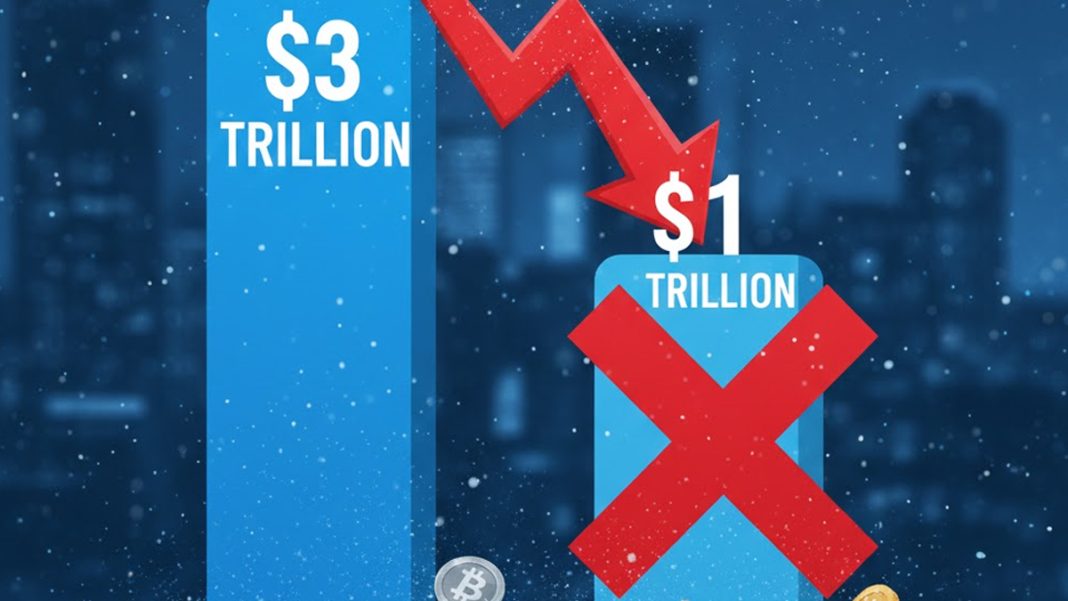
The fourth quarter results were a mixed bag. Coinbase beat sales estimates but missed adjusted EBITDA expectations, and the broader backdrop couldn’t be worse: crypto markets have shed $2.1 trillion in total value, Bitcoin has fallen 48% from October peaks, and trading volumes across the industry have cratered.
The Volume Problem
This is the core issue. Coinbase processed $174 billion in trading volume during Q4, which sounds large until you realize it’s down 62% year-over-year. The consumer segment, which drives about 85% of Coinbase’s revenue, took the hardest hit as institutional flows reversed and Bitcoin ETFs posted $1.09 billion in weekly outflows.
There were some bright spots. Derivatives trading grew 27% quarter-over-quarter. International revenue doubled to 18% of total revenue, driven by expansion into Brazil, Singapore, and the UAE. But these gains couldn’t fully offset the brutal decline in spot trading.
What’s raising eyebrows among analysts is that management is refusing to cut expenses despite the volume collapse. The company is maintaining flat expense guidance, which signals confidence in its diversification strategy—but it also means margins are getting squeezed hard.
Beyond Trading: The Diversification Story
One of the more interesting developments in the Q4 results is how much Coinbase has built outside of pure trading. Stablecoin revenue, custody, staking, and prediction markets now account for 28% of total revenue, up significantly from prior periods.
USDC circulation grew 15% to $42 billion, giving Coinbase a 12% share of the stablecoin market. Staking assets under management reached $32 billion. Coinbase Prime onboarded 45 new institutional clients. Prediction markets processed $850 million in election-related volume, opening up what could be a high-margin new vertical.
Even during the downturn, the customer base held up surprisingly well. Total customers hit 118 million, up 24% year-over-year, and monthly transacting users stayed steady at 8.4 million despite the market panic. Perhaps most encouraging: retail customers were net buyers during the downturn rather than panic sellers.
The Competitive Landscape Is Getting Tougher
Coinbase isn’t just fighting the bear market—it’s fighting intensifying competition. Binance still dominates global spot trading with 38% market share. OKX leads in derivatives. Kraken and Bitfinex are chipping away at U.S. custody business.
The regulatory environment is more complicated than it looks. While Trump’s deregulation rhetoric has been crypto-friendly on the surface, the SEC under Acting Chair Crenshaw hasn’t backed off. Stablecoin legislation has stalled. And the Genius Act, while helpful for compliance clarity, levels the playing field rather than giving Coinbase a specific advantage over competitors.
A CFTC derivatives probe remains unresolved, adding to regulatory overhang.
What Q1 2026 Looks Like
Management’s Q1 guidance was sobering. They’re projecting trading volume of $85-95 billion—a 40-50% sequential decline from an already weak Q4. With flat expense guidance, that means margins could compress to 12-15%.
The macro environment isn’t going to help. Fed Chair Kevin Warsh is keeping rates at 5.25-5.50%, Trump’s tariffs are pushing inflation forecasts to 4.2%, and the dollar at 108 is crushing risk assets broadly. Standard Chartered’s warning about Bitcoin potentially dropping to $50,000 triggered $775 million in liquidations. BlockFills halting withdrawals has raised prime brokerage contagion fears.
Coinbase’s Q1 will essentially be a test of how much the diversification strategy can cushion the blow from trading volume collapse.
The Bull Case
Despite all of this, Needham isn’t walking away from its Buy thesis, and the valuation math is interesting. At $230, the target implies 2.8x 2026 EV/Sales, compared to the five-year average of 4.2x. Forward price-to-earnings of 28x aligns with sector norms. Needham isn’t alone—H.C. Wainwright maintains a $350 target, and eight analysts rate Coinbase a Buy with an average target of $271.
The strategic catalysts are real. Bitcoin’s halving keeps the supply shock arithmetic intact. The $118 billion in ETF assets under management positions the industry for a major inflow wave once the Fed eventually pivots. BlackRock and Franklin Templeton are running real-world asset tokenization pilots on Coinbase’s infrastructure, which could drive significant custody inflows. International derivatives have hit a $1.2 trillion annualized run rate.
Coinbase also has $9.5 billion in cash, funding $2 billion in annual R&D on AI agents, wallet-as-a-service, and Layer 2 scaling. That balance sheet is a genuine competitive advantage when competitors are fighting for survival.
Needham highlighted share buybacks ($1.2 billion authorized) as a bullish catalyst, and the technical picture is improving slightly—RSI has climbed to 38, escaping deeply oversold territory, $160 is holding as support, and the $200 level (50-day EMA) is the next target.
The Bottom Line
Needham’s price target cut is an honest acknowledgment that crypto winter is real and Q1 is going to be painful. But the maintained Buy rating reflects a longer-term view: Coinbase has built a diversified business that can survive the trough, and the stock at current levels offers significant upside when the cycle eventually turns.
The core tension is this: flat expenses during a 50% volume drop is either a sign of management confidence in the recovery, or a margin disaster waiting to happen in Q1. The answer to that question will determine whether the bull thesis plays out on schedule or gets delayed further.
What’s clear is that Coinbase is structurally better positioned than most crypto companies to weather this storm. The balance sheet is strong, the diversification is real, and retail customers are buying rather than fleeing. The question isn’t whether Coinbase survives—it’s how bruised it looks when crypto spring finally arrives.