


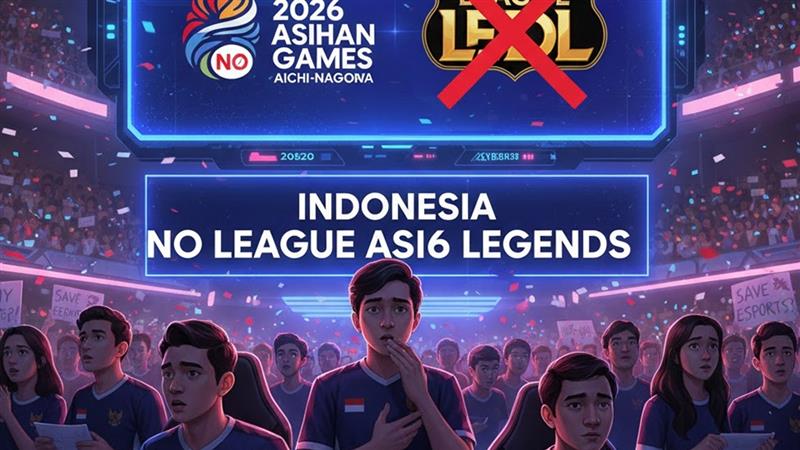
The League of Legends competition at the 2026 Asian Games is taking shape with a notable absence: Indonesia has become the third nation to confirm it won’t field a team in Aichi-Nagoya, joining host nation Japan and Thailand in withdrawing from one of esports’ most prestigious international tournaments.
The withdrawals are significant because all three nations have active, competitive League of Legends scenes. This isn’t a story about countries that never developed the game. It’s a story about budget realities and strategic choices reshaping how nations approach esports at the highest level.
How the Withdrawals Unfolded
Japan’s announcement came first and was arguably the most surprising. As the host nation, Japan’s decision not to field a League of Legends team despite competing in seven other esports titles—including Pokémon Unite, PUBG Mobile, Identity V, eFootball, Puyo Puyo, Gran Turismo, and fighting games—signaled a deliberate prioritization of titles where Japan sees stronger medal prospects over the PC MOBA where it has historically been less competitive regionally.
Japan’s League of Legends Japan League remains active, with SoftBank HAWKS Gaming and DetonatioN FocusMe competing in the LCP regional league. The talent exists. The decision is about resource allocation rather than capability.
Thailand followed, with the Thailand Esports Federation citing “policy alignment and National Sports Development Fund budget limitations.” The announcement drew domestic criticism from a Thai esports community that expected stronger institutional support, particularly given Thailand’s historically competitive presence in Southeast Asian tournaments.
Indonesia’s withdrawal came without official published rationale, but the pattern mirrors Thailand’s situation closely. Budget pressures across Southeast Asian esports programs intensified following 2025 funding cuts, and Indonesia faces the same calculation every national sports body navigates: how to allocate limited resources across competing priorities when esports medals compete for budget against established traditional sports disciplines.
What This Means for the Tournament
The combined withdrawal of Thailand and Indonesia removes two of Southeast Asia’s historically dominant League of Legends nations from the field. Alongside Vietnam, these three countries have consistently represented the region’s strongest competition at international events. With Indonesia and Thailand out, Vietnam carries the primary SEA hope, though confirmation of Vietnam’s participation hasn’t been finalized.
South Korea, China, and Chinese Taipei remain the presumptive favorites and are widely expected to confirm participation, though official announcements haven’t come yet. These three nations have dominated international League of Legends competition and their presence would make the reduced field no less competitive at the top.
The Laos qualifier in Kuala Lumpur in mid-June 2026 becomes the critical bottleneck for the entire region’s representation. Laos Esports Federation president Jonathan Sirisackda confirmed this event serves as the selection tournament for Southeast Asian qualification. With fewer nations competing for SEA slots, the pressure on the teams that do qualify intensifies—they carry regional representation weight that would have been distributed more broadly with full participation.
The first host nation absence from League of Legends since Indonesia’s 2018 demonstration participation marks a notable historical footnote. China competed as host in the 2022 Hangzhou Asian Games. Japan’s hosting role made its non-participation particularly striking.
The Strategic Shift Toward Mobile
The withdrawal pattern reveals something meaningful about where national esports investment is heading across Southeast Asia. Japan’s alternative title selections, Thailand’s policy alignment language, and Indonesia’s likely budget calculations all point in the same direction: mobile and accessible platforms are receiving priority over PC infrastructure-intensive titles.
Mobile Legends: Bang Bang and PUBG Mobile feature in the Asian Games esports program alongside League of Legends, and these titles present a different cost structure for national programs. Mobile esports requires less specialized infrastructure, reaches broader player bases, and aligns with the smartphone-first gaming demographics that dominate Southeast Asian markets.
The economics are straightforward. Building and supporting a competitive national League of Legends program requires high-performance PC setups, dedicated practice facilities, coaching infrastructure, and sustained organizational support. A nation making difficult budget decisions will find it easier to justify investment in mobile titles where the infrastructure costs are lower and the domestic player base is larger.
This mirrors broader technology democratization trends playing out across the region. Just as AI applications are being designed around smartphone access rather than desktop infrastructure to reach broader Southeast Asian populations, esports investment is concentrating where the infrastructure barriers are lowest.
The Opportunity This Creates
The three-nation absence reshapes qualification mathematics in ways that create genuine opportunity for nations that might otherwise face longer odds. India’s esports program, with demonstrated strength in PUBG and BGMI competition, finds a regional landscape with meaningful gaps in the competitive field.
The Kuala Lumpur qualifier in June becomes the decisive moment for determining which Southeast Asian representation actually reaches the Aichi-Nagoya competition. Nations that committed to participation and maintained their programs through the funding pressures that deterred Thailand and Indonesia will find a more navigable path to qualification.
The competitive intensity at the top of the field won’t diminish—South Korea and China will compete regardless of who else participates. But the structural changes in SEA representation create openings that didn’t exist when the region’s traditional powerhouses were all present.
What Comes Next
The June Kuala Lumpur qualifier is the next milestone worth watching. It will determine Southeast Asian representation and clarify whether the three-nation withdrawal has fundamentally altered the regional competitive hierarchy or simply created a one-cycle opportunity for nations that maintained their commitments.
The broader question the 2026 Asian Games League of Legends situation raises is whether the withdrawal pattern represents a temporary budget cycle response or a more durable strategic shift in how SEA nations approach PC esports investment. If funding constraints persist and mobile esports continue growing their institutional support, the composition of international League of Legends competition from Southeast Asia may look structurally different for years rather than just this cycle.
For now, the field is smaller, the Kuala Lumpur qualifier carries more weight than anticipated, and the 2026 Asian Games League of Legends competition will unfold without three of the region’s most historically active programs. The teams that do show up will compete for medals in a changed landscape—and the nations that committed despite fiscal pressure may find that commitment rewarded.