


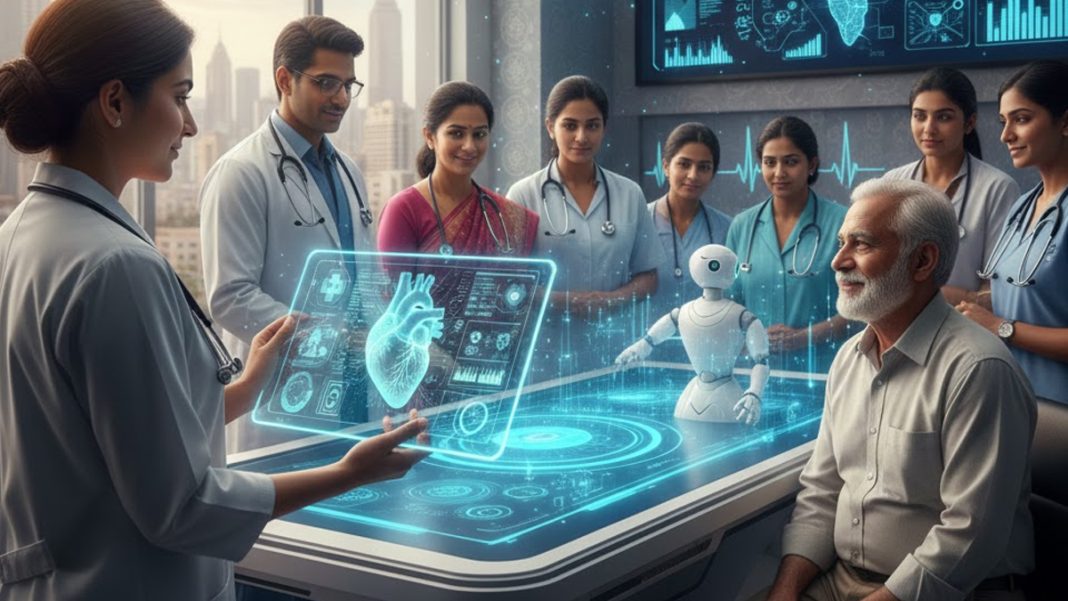
India’s approach to artificial intelligence in healthcare is moving from pilot programs to national infrastructure in 2026, with real deployments reaching populations that have never had reliable access to quality medical care. The scale of what’s being attempted—and what’s already working—deserves serious attention.
The central challenge India is solving isn’t the same one Western healthcare systems are grappling with. The question isn’t how to make good healthcare more efficient. It’s how to deliver any meaningful healthcare at all to hundreds of millions of people in Tier-II and Tier-III cities and rural areas where specialist physicians are essentially absent.
Converting Decades of Paper Into Usable Data
Before AI can improve healthcare delivery, it needs data to work with. India’s healthcare records are a fragmented mess of paper files, handwritten notes, and incompatible digital systems accumulated across decades of disconnected institutional development. None of it talks to anything else.
Google’s collaboration with the National Health Authority is tackling this foundational problem directly—processing millions of unstructured clinical notes into FHIR (Fast Healthcare Interoperability Resources) standards that make the data machine-readable and interoperable. This is unglamorous infrastructure work, but it’s the prerequisite for everything else. AI diagnostic systems, predictive outbreak modeling, and population health analytics all require structured, accessible data. Converting India’s existing records into that format is the necessary first step.
MeitY’s $1 billion digital health fund is supporting this infrastructure buildout alongside specific application areas: obesity and antimicrobial resistance screening, and mental health support through vernacular chatbots reaching the 80% of the population with smartphone access. The vernacular emphasis is critical—mental health support that requires English proficiency serves a small fraction of the population that needs it.
Diagnostics Where Doctors Aren’t
Qure.ai’s chest X-ray tuberculosis screening has reached more than 1,000 public facilities. This deployment addresses one of the most persistent and deadly gaps in Indian public health: TB is both treatable and diagnosable, but diagnosis has historically required trained radiologists concentrated in urban centers. Patients in rural areas either travel significant distances for diagnosis or go undiagnosed entirely.
AI screening that can analyze a chest X-ray at a rural health facility without a radiologist present isn’t replacing specialist care—it’s providing a diagnostic capability that simply didn’t exist in those locations before. The same logic applies to Rocket Health’s primary care AI bridging specialist gaps in underserved areas. When the alternative to AI-assisted diagnosis is no diagnosis at all, the bar for the technology is different than when it’s competing with existing specialist access.
SGPGIMS’s Tele-ICU models are expanding statewide after demonstrating results in pilot deployments. Remote intensive care monitoring—where AI systems track patient vitals and flag deterioration for specialist review—extends the reach of ICU expertise beyond the physical walls of tertiary care hospitals. A critically ill patient in a district hospital can receive oversight from specialists at a major medical center, with AI handling the continuous monitoring that would otherwise require dedicated on-site staff.
From Reactive to Preventive
The ambition extends beyond improving access to existing healthcare. India is attempting to shift the entire system from reactive treatment to preventive intervention, using AI to identify risks before they become crises.
The disease outbreak modeling work builds on infrastructure developed for agricultural applications. The same data pipelines tracking monsoon patterns and pest outbreaks with 87% accuracy can model disease spread through populations—identifying high-risk areas for intervention before outbreaks establish themselves. Maharashtra’s MahaAgriX platform, integrating health and agricultural data, reflects the recognition that these systems are more powerful combined than separate. Nutrition, environmental conditions, agricultural practices, and disease incidence are interconnected in ways that siloed data systems can’t capture.
The IndiaAI-WHO partnership is systematically documenting these approaches as Global South case studies, feeding evidence into the UN’s new 40-member AI Scientific Panel and into international governance discussions. India isn’t just building for its own population—it’s building models that Bangladesh, Kenya, and Indonesia can adapt and deploy.
Regulatory Infrastructure
Deployment at this scale requires regulatory frameworks that don’t yet exist in most countries. India’s membership in the HealthAI Global Regulatory Network aligns it with UK and Singapore best practices, creating clinical AI regulatory pathways that enable public system deployment rather than blocking it.
The IndiaAI Innovation Challenge 2026, funding AYUSH and MSME solutions up to ₹1 crore for analyzing complex public health datasets, is building the domestic startup ecosystem needed to sustain innovation beyond initial government-led deployments. The goal is creating an environment where Indian companies are developing AI healthcare solutions for Indian contexts rather than adapting Western tools that weren’t designed for this population.
NATHEALTH’s 2026 mandate is explicitly demanding measurable outcomes rather than foundational reforms—a signal that the sector has moved past the phase where building infrastructure counts as success. Results in patient outcomes, diagnostic accuracy, and care access are now the metric.
The Localization Advantage
India’s healthcare AI has a structural advantage that Western imports lack: it’s trained on Indic data representing the actual patient population being served. A diagnostic model trained on chest X-rays from European populations will systematically underperform on Indian patients with different disease prevalences, different genetic backgrounds, and different presentations of common conditions. Models trained on Indian clinical data don’t have that problem.
The PRIP scheme’s $12 billion research and development investment is explicitly targeting MedTech localization, with a goal of reducing import dependence by 40%. This isn’t just economic nationalism—it’s recognition that imported medical technology often doesn’t serve Indian patients as well as locally developed alternatives designed for local conditions.
The 780 Indian languages that represent a challenge for general AI deployment become an advantage in healthcare: vernacular mental health chatbots that a patient can use in their native language are categorically more accessible than English-language alternatives. India’s linguistic diversity, properly addressed, becomes a capability moat.
What Budget 2026 Signals
The Budget 2026 prioritization of AI healthcare transition from pilots to execution is the clearest signal of genuine commitment. Government pilot programs are easy to launch and easy to abandon. Infrastructure investment at the scale being deployed—₹10,000 crore for the sovereign AI stack, $1 billion for digital health, ₹500 crore for Maharashtra’s integrated agricultural and health data platform—represents commitments that create institutional momentum and accountability.
The framing matters too. Budget language treating digital health as “core infrastructure” rather than “experimental add-on” signals that healthcare AI has crossed the threshold from innovation budget to operational budget. That shift in how spending is categorized typically precedes the kind of sustained, multi-year investment that produces systemic change.
Global Capability Centers accelerating HealthTech innovation are bringing multinational expertise into the Indian ecosystem while keeping the development work and intellectual property domestically anchored. The combination of global knowledge and local context is precisely what produces solutions that work at Indian scale.
The Honest Assessment
The ambition is genuine and the early results are real. Qure.ai’s TB screening deployment, SGPGIMS’s Tele-ICU expansion, and Rocket Health’s primary care AI are functioning systems serving actual patients—not demonstrations or controlled trials.
The execution challenges are equally real. Converting millions of paper records to FHIR standards at national scale is a multi-year technical project with significant data quality and governance challenges. Deploying AI systems in facilities with inconsistent power and connectivity requires hardware and software resilience that urban-focused development often underestimates. Training healthcare workers to use AI tools appropriately—understanding both their capabilities and their limitations—is a human change management challenge as much as a technical one.
The 2026 inflection from intent to impact that NATHEALTH and MeitY are targeting is achievable for specific applications in specific contexts. Nationwide transformation of India’s healthcare system through AI is a decade-long project, not a single year’s accomplishment.
What 2026 can deliver—and appears to be delivering—is proof at sufficient scale that the approach works, the infrastructure to sustain it, and the regulatory frameworks to govern it responsibly. That’s the foundation. The healthcare renaissance India is attempting will be built on top of it over the years that follow.