

When UN Secretary-General António Guterres warns against repeating the exclusions of the industrial revolution, he’s pointing at something specific: the pattern where transformative technology gets developed by and for wealthy nations, while the rest of the world waits decades to access its benefits—if they ever do at all.
With the India AI Impact Summit opening February 16 in New Delhi, the UN is using the global spotlight to showcase what AI looks like when it’s actually built for the Global South rather than adapted from Western models as an afterthought.
The Applications That Tell the Story
The most compelling evidence for democratized AI isn’t found in enterprise software or large language model benchmarks. It’s in places like rural India, Pakistan, and Kenya, where fodder cutter accidents devastate thousands of women annually—removing fingers, hands, and the ability to perform the agricultural and domestic work that sustains their families and livelihoods.
AI-powered prosthetics developed through local innovation are now affordable for these communities in ways that imported Western medical devices never were. The difference isn’t just cost. It’s that the prosthetics are designed for the actual tasks these women need to perform: harvesting crops, cooking meals, doing embroidery work. A prosthetic optimized for keyboard use in an office environment solves a different problem than one optimized for the physical demands of rural agricultural life. Local innovation, trained on local needs, produces locally appropriate solutions.
The same logic applies to health diagnostics. Low-cost AI diagnostic models trained on regional patient data are outperforming Western imports in local contexts—not because the underlying technology is superior, but because the training data reflects the actual disease patterns, presentations, and demographic characteristics of the populations being served. A diagnostic model trained primarily on data from European and North American patients will systematically underperform for populations with different genetic backgrounds, different disease prevalences, and different presenting symptoms.
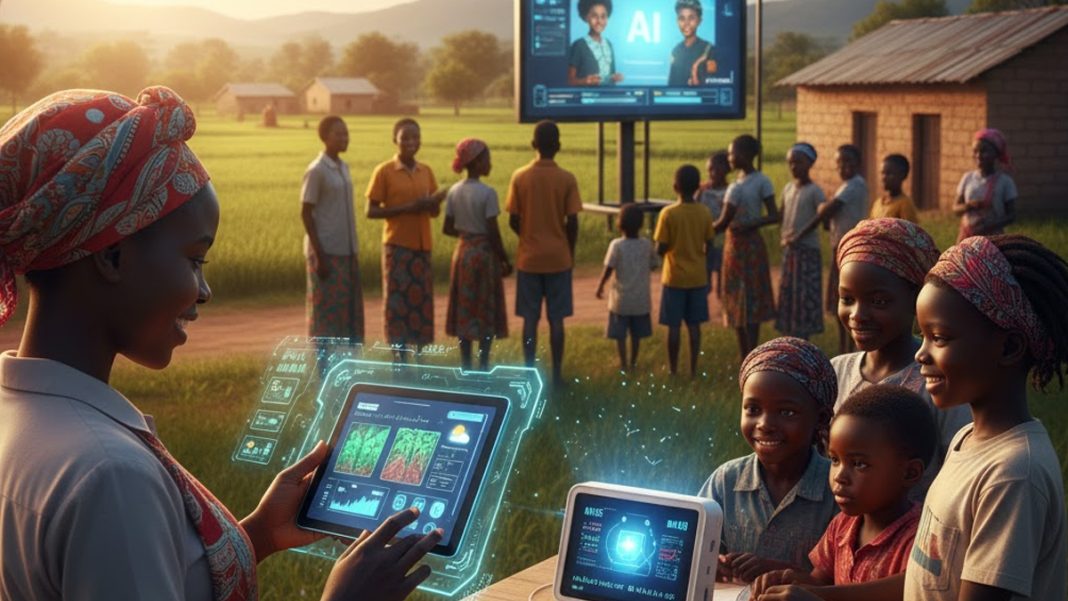
Agriculture platforms predicting monsoons and pest outbreaks with 87% accuracy are serving 15 million smallholders in ways that commercial precision agriculture tools designed for large-scale Western farming operations never could. The delivery mechanism—WhatsApp advisories and voice interfaces in local languages—reflects a genuine understanding of the infrastructure and literacy constraints of the target users.
The Concentration Risk Is Real
Guterres and UN technology adviser Amandeep Gill are making a structural argument that deserves serious attention. The Global South represents 85% of humanity but contributes minimal training data and infrastructure to the AI systems being built globally. That imbalance has compounding consequences.
AI systems trained primarily on data from wealthy nations encode the priorities, contexts, and assumptions of those nations. When deployed globally, they systematically underperform for populations whose experiences weren’t represented in training. This isn’t a minor calibration issue—it’s a fundamental mismatch between what the technology was built to do and what the people using it actually need.
The infrastructure concentration is equally significant. Computing power, engineering talent, and research capacity for frontier AI development are concentrated in a handful of companies and countries. Nations without access to that infrastructure can consume AI products built elsewhere, but they can’t shape what gets built or ensure it serves their populations well.
CSIS analysts are warning that World Bank and IMF involvement in AI governance co-design is necessary to prevent the technology from becoming another mechanism of economic stratification rather than a tool for development. Wharton researchers are advocating for “prosocial AI” frameworks tailored to local contexts through South-South collaboration—developing nations sharing approaches with each other rather than waiting for Northern nations to develop solutions and export them.
What India Is Actually Building
India’s response to this challenge is more substantive than rhetoric. MeitY’s IndiaAI Mission has allocated ₹10,000 crore for building a sovereign AI stack—infrastructure and capabilities that don’t depend entirely on foreign platforms. Jio and Yotta are scaling GPU clusters that are beginning to approach the capacity of specialized Western cloud providers.
The platforms showcased at the UN events ahead of the summit represent genuine technical achievement at scale. Bhashini’s unified translation engine covering 22 official languages plus dialects isn’t just a language tool—it’s infrastructure that makes every other AI application accessible to populations who don’t speak English or Hindi. Gyan Bharatam’s digitization of 10 million Sanskrit and Pali manuscripts using AI OCR with 98% accuracy across ancient scripts is solving a problem no Western technology company had strong incentive to solve. Adi Vaani’s preservation of 780 tribal languages through AI speech synthesis trained on 50,000 hours of oral recordings is creating digital immortality for linguistic traditions that would otherwise vanish within a generation.
Maharashtra’s AI4Agri policy, backed by ₹500 crore in first-phase funding, is building agricultural AI infrastructure specifically designed for smallholders averaging 1.5 hectares—a fundamentally different design challenge than precision agriculture for industrial farming operations.
The artisan integration work is generating $1.2 billion in annual exports while sustaining traditional craft communities. Cultural NFTs on blockchain infrastructure are creating royalty streams for artists whose work was previously copied without compensation. These aren’t pilot programs. They’re operating at national scale.
The Summit as Geopolitical Signal
The India AI Impact Summit is the first major Global South AI gathering following the UK and French summits that shaped much of the current international AI governance conversation. The significance of that sequencing is deliberate. The UK and French summits produced frameworks reflecting European and American priorities and risk concerns. New Delhi is asserting that those frameworks are incomplete without Global South perspectives on what AI risks and opportunities actually look like for 85% of humanity.
Guterres’ personal participation validates India’s positioning as a neutral convenor capable of bridging U.S.-China tensions. The presence of Macron, Lula, Gates, Hassabis, and Amodei signals that this isn’t a parallel conversation happening separately from the main AI governance discourse—it’s becoming part of the main conversation.
The 117-2 UN vote approving the Independent International Scientific Panel on AI, feeding directly into the summit’s discussions, reinforces the point. The overwhelming majority of the world’s nations have decided that AI governance shouldn’t be determined exclusively by the nations leading AI development.
The Economic Case
The development argument for AI democratization is often framed in humanitarian terms, which is legitimate but incomplete. The economic case is equally compelling.
AI unlocking ₹15 lakh crore in knowledge economy value from India’s cultural heritage isn’t charity—it’s identifying economic assets that currently sit inert because the tools to activate them didn’t exist. Maharashtra targeting a 25% agricultural productivity leap adding ₹2 lakh crore to state GDP represents real economic growth driven by technology deployment. The $1.2 billion in artisan exports represents market creation, not aid.
Amandeep Gill’s emphasis on government subsidies in Southeast Asia, Africa, and India enabling researchers and small firms to compete with well-capitalized Western AI companies reflects a straightforward industrial policy logic: strategic public investment in enabling infrastructure creates competitive capacity that market mechanisms alone won’t produce fast enough.
What Equitable AI Actually Requires
The gap between aspirational framing and operational reality is where these initiatives face their hardest tests. Low-resource language AI models systematically underperform compared to English-language models because the training data imbalance is enormous and closing it requires sustained investment. Rural connectivity gaps mean that voice AI advisories don’t reach the farmers most isolated from markets and information. Digital literacy barriers require human intermediaries at scale—Common Service Centers, agricultural extension workers, community health workers who can translate AI-generated recommendations into locally appropriate action.
None of these are arguments against the approach. They’re arguments for taking the operational challenges as seriously as the technological ones. The prosthetics work, the agricultural platforms, and the manuscript digitization are proof that locally designed AI for local contexts produces better outcomes than imported solutions. Scaling that proof into national infrastructure is the work of the next decade.
Guterres’ framing—that AI is moving at “lightning speed” and that the window to shape its trajectory toward equitable outcomes is closing—captures the real urgency. The patterns being established now, about who develops AI, whose data trains it, whose needs shape its applications, and whose governance frameworks constrain it, will be significantly harder to change once they’re entrenched.
The Global South isn’t asking for AI as charity. It’s asserting the right to shape technology that will determine its economic future—and demonstrating, in prosthetics workshops and agricultural advisory platforms and manuscript digitization centers, that it has the capacity to do so.