

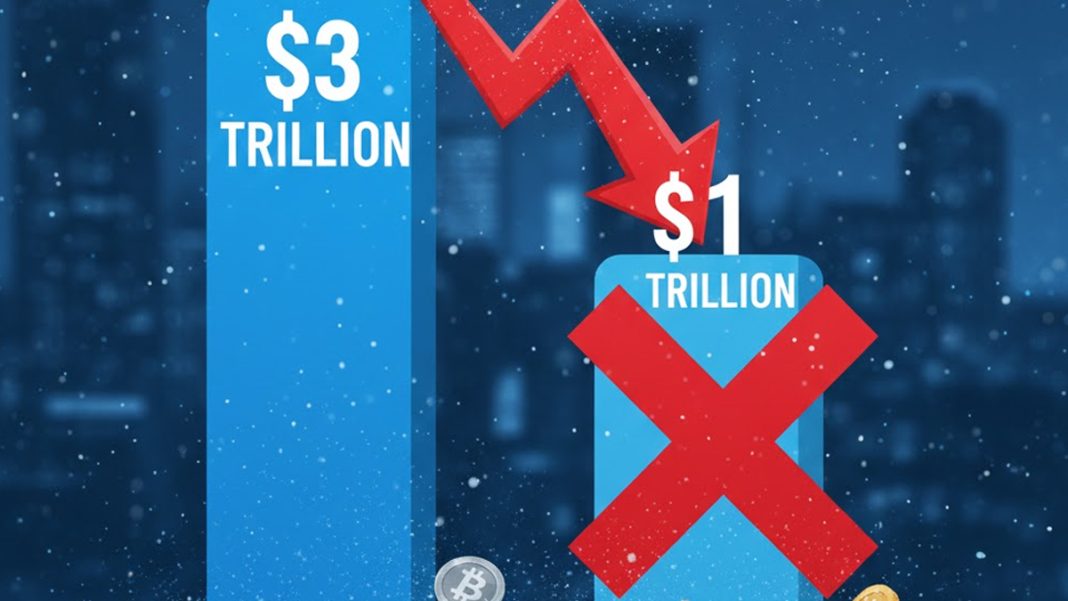
The cryptocurrency market is in the grip of its harshest downturn in years. Total market capitalization has shed $2.1 trillion—a 48% collapse—from October 2025 peaks. Bitcoin is testing $66,000, Ethereum has fallen below $1,950, and smaller cryptocurrencies have been eviscerated by 60-80%. What’s being called the “Coldest Crypto Winter” of 2026 is being driven by a brutal combination of Federal Reserve stubbornness, tariff-driven inflation, and a cascade of institutional failures.
The severity is hard to overstate. Standard Chartered already slashed its Bitcoin year-end target to $100,000 while warning of a potential $50,000 capitulation floor. Bloomberg Intelligence’s Mike McGlone went further, projecting Bitcoin could revisit $10,000 amid post-inflation deflation dynamics reminiscent of 2008’s 50% equity wipeout. Weekly liquidations are hitting $775 million peaks, miner operations are shutting down, and ETF outflows have accelerated to $12 billion quarterly—surpassing even 2022’s FTX collapse winter in terms of duration and leverage exposure.
What’s Driving the Carnage
The macro environment is the primary culprit. Federal Reserve Chair Kevin Warsh is holding firm at 5.25-5.50% interest rates with no signs of pivoting, crushing any hopes for near-term relief. Trump’s tariff offensive—25% on Mexico and Canada, 60% on China—is forecasting consumer price inflation spikes to 4.2%, strengthening the dollar index to 108 and punishing all risk assets.
Global manufacturing indicators at 47.8 signal recession. A stronger-than-expected U.S. jobs report eliminated any remaining odds of a March rate cut. Corporate Bitcoin treasury accumulation has run out of steam—MicroStrategy has paused its ATM program, and miners are facing all-in costs around $40,000 that are barely covered by current prices.
The institutional failures are compounding the fear. BlockFills halting withdrawals triggered prime brokerage contagion fears across the sector. Coinbase posted a $95 million Q4 loss on a 62% volume collapse. Exchange reserves are at four-year lows as long-term holders hunker down and refuse to sell.
How Markets Are Breaking Down
The internal market structure tells a story of systematic fracturing. Bitcoin dominance has surged to 58%—the highest since November—as money drains out of alternative cryptocurrencies and into Bitcoin as a relative safe haven. The Ethereum/Bitcoin ratio is testing multi-year lows at 0.029. XRP funding rates are at 10-month lows.
Futures open interest has cratered 28% to $92 billion, the lowest since ETF approvals first launched. Funding rates have swung to -0.028%, incentivizing short positions. Hedge fund margin calls have forced $4.2 billion in cascade liquidations.
Standard Chartered identified ETF flows as essentially the only remaining demand driver for Bitcoin—and now even those are reversing. BlackRock and Fidelity redemptions are overwhelming whatever spot buying is happening. A miner difficulty adjustment of -5.8% is coming as hashrate drops signal the first signs of supply shocks from miners shutting down.
The Broader Ecosystem Is Hurting
The pain isn’t limited to prices. DeFi total value locked has evaporated 65% to $89 billion. NFT floor prices are down 95% from peaks. Stablecoin scrutiny has intensified following Tether’s fresh minting.
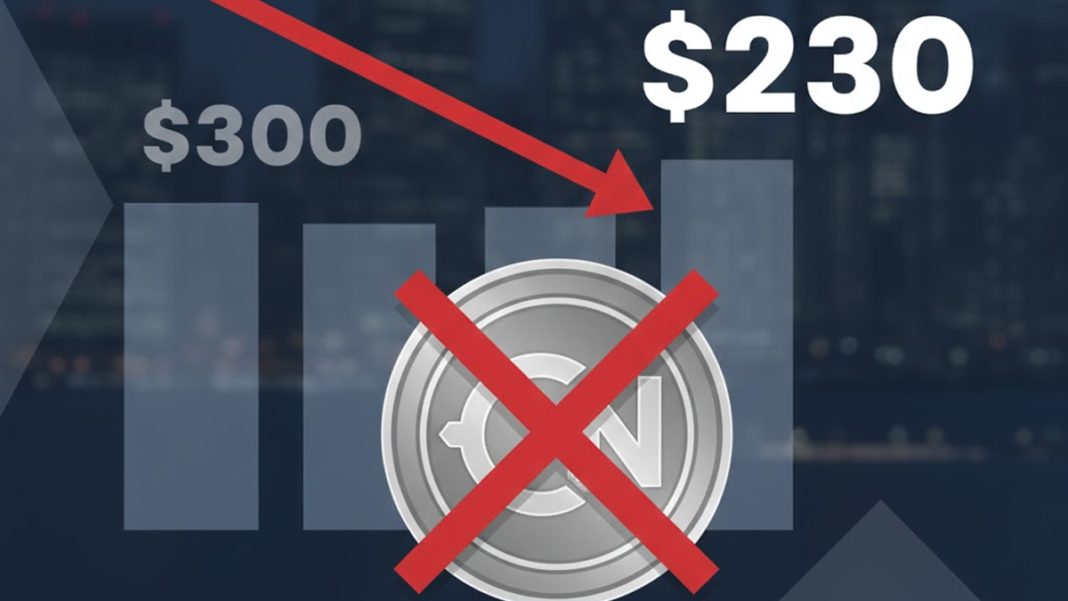
Coinbase has seen its price target slashed to $230 amid Q1 volume warnings projecting another 40-50% sequential drop. Robinhood’s crypto revenue cratered 72%. Prediction markets collapsed after the election cycle ended. Staking yields spiked to 18%—a counterintuitive sign that capital is fleeing riskier crypto activities toward the perceived safety of staking returns.
JPMorgan is turning cautiously bullish for the second half of 2026, projecting stabilization after capitulation completes. But they’re not calling a bottom yet.
How This Compares to Previous Cycles
Historical context matters here. Post-halving bear markets have averaged 365 days with drawdowns of 70-85%. The current decline—105 days at 48%—actually tracks the midpoint of that historical range, suggesting this isn’t necessarily worse than past cycles, just faster in some ways.
Tier One Trading analysis shows October-November bottoms have an 80% historical probability. The typical pattern is that February and March deliver relief rallies that trap optimistic buyers, May worsens, July begins a rebound, and October brings the final capitulation. If history holds, we’re somewhere in the middle of that arc.
The MVRV Z-Score at 1.8 signals undervaluation matching previous cycle floors. The 2021 precedent is instructive—Bitcoin corrected 54% from $69,000 but recovered 4x within 180 days. Patience was rewarded with asymmetric returns for those who held through the pain.
How Different Investors Are Responding
Strategies are diverging sharply based on risk tolerance and time horizon.
Long-term holders are dollar-cost averaging at key support levels—$58,000 for Bitcoin, $1,725 for Ethereum—using logarithmic regression bands as guides. Active traders are shorting rallies below the $68,000 EMA with stops at $64,000, treating bounces as selling opportunities rather than recovery signals. Speculators with high risk tolerance are waiting for a $40,000-$50,000 capitulation event to establish multi-year positions for the next cycle recovery.
The universal consensus: avoid leverage entirely. The $775 million in weekly liquidations is a brutal reminder of what happens to leveraged positions in this environment. A sensible portfolio allocation for weathering the storm might look like 60% Bitcoin, 25% Ethereum, and 15% stablecoins.
Smart money appears to be accumulating quietly through over-the-counter trading rather than on exchanges, avoiding the price impact that large exchange orders would create. Exchange flow data confirms conviction among this group even as retail panic spreads.
Why the Long-Term Bull Case Survives
Despite everything, the fundamental case for crypto recovery remains mathematically intact. Bitcoin’s halving means block rewards are now just 3.125 BTC—the supply shock is real and doesn’t care about macro conditions. The $118 billion in ETF infrastructure is positioned to capture a massive inflow wave the moment the Fed pivots. Trump’s crypto reserve rhetoric, however inconsistent with current market reality, persists.
Real-world asset tokenization pilots from BlackRock (BUIDL) and Franklin Templeton are continuing to drive custody inflows into crypto infrastructure. Layer 2 scaling solutions are maturing, making blockchain networks more practical for everyday use.
The capitulation process, brutal as it is, serves a purpose. It wipes out over-leveraged miners, forces out speculative positions, and reprices institutional exposure to more sustainable levels. What’s left after that clearing process is a stronger, less leveraged market that can actually sustain the next bull cycle.
The Bottom Line
This is genuinely the coldest crypto winter in recent memory, and there’s no honest way to sugarcoat the pain. Macro forces are overriding on-chain fundamentals, and they’ll continue doing so until the Fed changes course or inflation convincingly breaks lower.
The $50,000 level for Bitcoin represents a powerful confluence of support—realized price, the 200-week moving average, and logarithmic regression bands all point there as the most likely floor if capitulation continues. Getting through that level and surviving is what separates this cycle’s winners from its casualties.
History consistently favors asymmetry for those who hold through crypto winters. The people who bought during 2018’s 84% crash, through 2020’s pandemic collapse, and through 2022’s FTX contagion all saw extraordinary returns in the years that followed.
That doesn’t make the current pain less real. But for investors with time horizons measured in years rather than weeks, crypto’s coldest winter is also its most historically reliable setup for what eventually comes after.