

If you’ve tried to sign up for a crypto exchange in India recently, you’ve probably run into KYC rules right away. Yes, it is annoying. Yes, it takes time. You might be wondering why you have to send in a million documents just to trade Bitcoin, even though crypto is supposed to be all about privacy and decentralization.
Let’s talk about what KYC is really like in Indian crypto exchanges, why it’s there, and how to get through it without going crazy.
What is KYC, and why do so many people want your papers?
“Know Your Customer” (KYC) means “show that you’re a real person and not a scammer or money launderer.” Banks have always done this. Now crypto exchanges have to do it too, especially in India where regulators are keeping a close eye on crypto activity.
The main point is that exchanges need to check who is using their platform. This is supposed to cut down on money laundering, fake accounts, fraud, and all the other shady things that happen when people can make anonymous accounts. It also makes crypto more like traditional finance, which is good or bad depending on what you think crypto should be.
Most Indian users find KYC to be a pain. That’s not just you. But exchanges do it in part because the law says they have to and in part to protect themselves legally. Without KYC, banks and the government would look at them even more closely.
The Real KYC Process (Step by Step)
First, you sign up. It’s pretty simple: enter your email address and mobile number, verify with an OTP, and make a password. Simple enough. At this point, some exchanges let you look around and see the interface, but most won’t let you deposit INR, withdraw money, or do any real trading until you finish KYC. So you’re pretty much stuck.
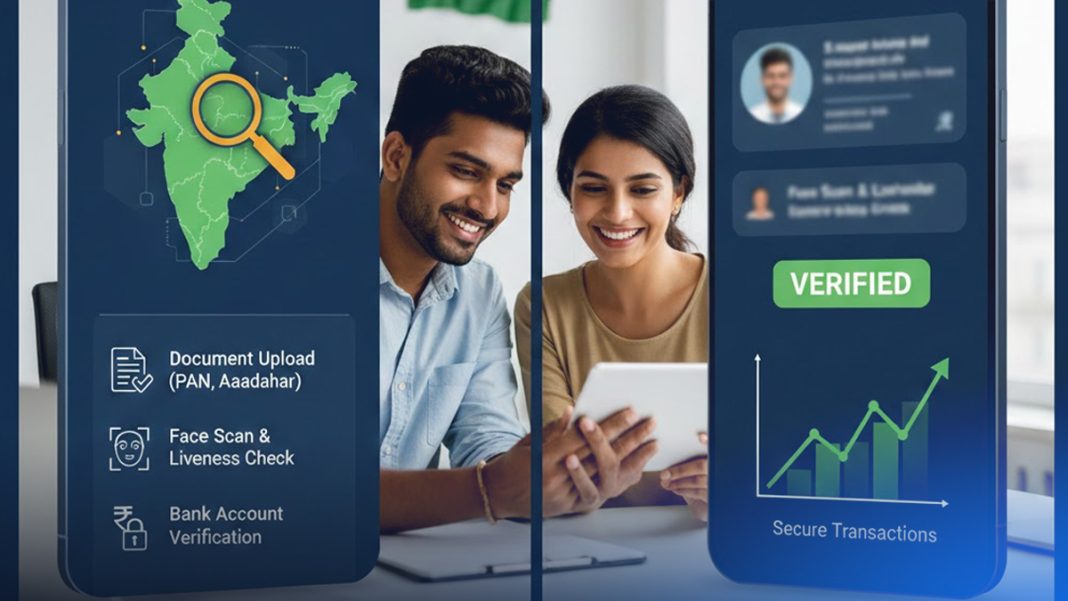
The next step is to upload the document. This is where it gets real. Exchanges in India almost always want your PAN card first. Why PAN? Because it is tied to your tax ID and is used for almost all financial transactions in the country. They know that the government can find you through PAN, which makes them happy with their compliance.
Then they need proof of where you live. Depending on which exchange you use, this could be your Aadhaar card, passport, voter ID, driver’s license, or even utility bills. Some platforms use Aadhaar-based verification systems, which are safe ways to check Aadhaar data without the exchange actually keeping all of your information. Some people don’t use Aadhaar at all because they’re worried about privacy and use other documents instead.
Next is the selfie situation. Yes, you need to take a picture of yourself in real life. The exchange wants to make sure that your ID photo and your face are the same. Many exchanges now use liveness detection technology to make sure you’re not just showing them a printed photo or a screenshot. They want to stop identity theft, which is when someone uses stolen documents with their own face on them.
Does it feel a little too much? Of course. But because so many people have tried to open accounts with fake IDs or stolen documents, exchanges had no choice but to put these rules in place.
Some exchanges take video KYC even further. This is when things get even more annoying. You may need to make a short video or join a live call to prove who you are. Banks and lending apps already do this, so crypto exchanges thought, “Why not?” Video KYC usually happens when the platform wants to make things safer or when something you do with your account sets off a risk flag. Be ready for it, even though not every exchange needs it.
The Things That Are Going On Behind the Scenes
Exchanges are also keeping track of other things you might not know about while you’re going through these hoops. They keep an eye on everything, like your device information, where you’re logging in from (IP addresses), strange login patterns, strange transaction behavior, and big withdrawals that happen out of the blue.
They may temporarily freeze your account and ask for more documents or explanations if something seems off. This is against AML (Anti-Money Laundering) rules and is meant to stop fraud. It’s not fair when it happens to you, even though you’re not doing anything wrong, but it’s how they try to catch real criminals.
Why KYC is Important for More Than Just Annoying You
This is something that most people don’t think about: It’s not just that the exchange is hard to use. Banks that let these exchanges deposit and withdraw INR have strict rules for verifying customers. If exchanges don’t keep their KYC up to date, banks might stop processing payments for them. So, exchanges have to do KYC in part because their banking partners want them to.
There’s also the tax angle. India now taxes crypto gains, so you need to make sure your identity is correct to stay legal. Exchanges give you transaction histories and reports that you can use to figure out your tax profits and losses. That whole system falls apart without KYC.
KYC makes the ecosystem more open and lessens the number of anonymous accounts that could be used for bad things, whether you like it or not. India is making a trade-off between letting people use cryptocurrency and keeping control over the rules.
How to Get Through KYC Without Any Problems
Want to avoid headaches? This is what works:
Make sure that the information on your PAN matches your name, date of birth, and documents exactly. Even small differences can cause rejections. Upload pictures that are clear and well-lit, with no blur or glare. Don’t use someone else’s papers; that will get you banned for good faster than you can say “decentralization.”
When you upload sensitive documents, make sure your device is safe. As soon as your account is active, turn on two-factor authentication. Don’t give your OTPs or login information to anyone who says they’re from customer support. That information will never be asked for by exchanges.
Read the reason carefully if your KYC is turned down. Most of the time, it’s something that can be fixed, like photos that are blurry, details that don’t match, or documents that are no longer valid. Instead of making a new account, fix the problem and send it back in. Making a new account will only make things more difficult.
The Big Picture
KYC is becoming a requirement, not an option, for Indian crypto exchanges. It does take away the anonymous and privacy-focused parts of crypto that early users liked, but it makes it safer, meets compliance needs, and builds trust with regulators and traditional finance.
As Indian crypto rules change over time—and they will—exchanges will probably make their verification systems even better. Some people might add re-verification every so often. Some people might set transaction limits based on how well they can verify. From here on out, things will only get more organized.
For most people, knowing how KYC works just helps you trade without running into account limits or getting locked out all the time. Philosophically, it’s not what crypto was supposed to be about. But that’s how it is to trade crypto in India right now.
The sooner you finish your KYC, the sooner you can focus on what really matters: figuring out this crazy market and not losing all your money. To be honest, KYC is the easy part. Are you good at trading crypto? That’s the hard part.