

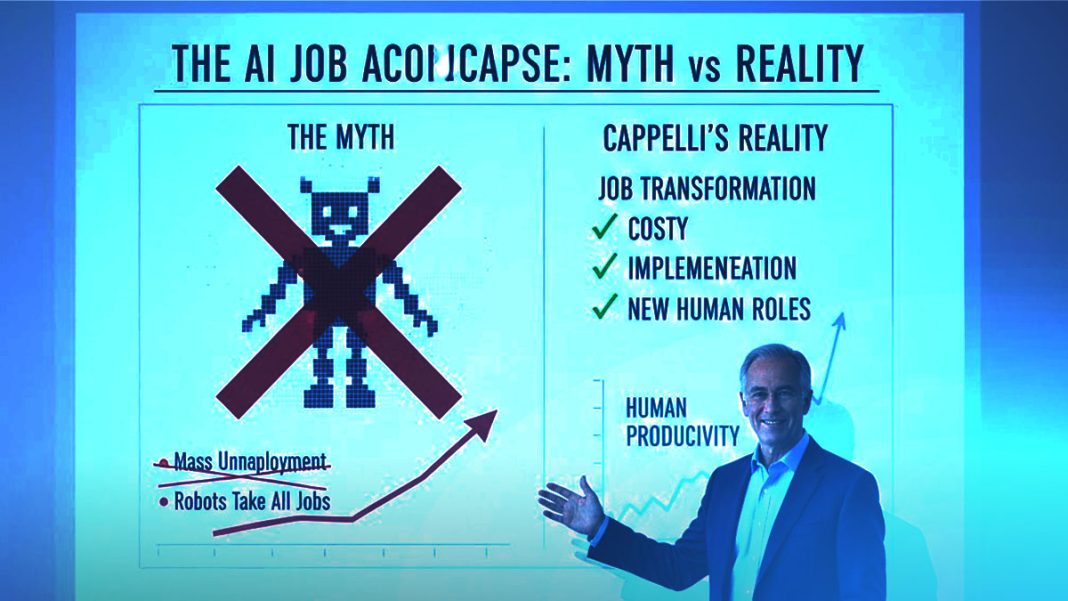
The doom loop says that AI will come and destroy jobs left and right, leaving people unemployed and their careers gone overnight. It’s the story that people tell to scare each other in both boardrooms and bars. Peter Cappelli, a Wharton management expert who has spent years studying labor trends, says that the “AI job apocalypse” story doesn’t hold up when you look at how real businesses work every day.
Cappelli gets right to the point: most of the panic is based on what people think will happen, not what is actually happening. Those shiny reports say that if AI can do a job, businesses will quickly and completely automate it. A call to wake up: Businesses aren’t like labs; they’re careful creatures that have to deal with budgets, tech problems, office politics, and fears of lawsuits. Rollouts don’t run; they crawl.
What is your biggest blind spot? Putting jobs and tasks together. There’s no such thing as a monolithic job; it’s a mix of things. 40% of the time is spent doing boring tasks like filling out spreadsheets or sending out the same emails over and over again (AI playground), but what about the rest? People are good at schmoozing clients, dealing with crises, and coming up with new ideas. Sure, AI takes the easy parts. But bosses don’t throw away roles; they remix them. Let bots handle the data crunching and people handle the strategy. Seen it in factories, offices, and all over.
History backs him up completely. Do you remember the mechanization panic of the 1800s? Luddites breaking looms. Computers in the 1980s? “White-collar wipeout!” Boom in the internet? Same shouts. Jobs didn’t go away; instead, gigs changed, new ones appeared (like web designers and data scientists), and hiring sprees happened when output surged. AI is just chapter whatever; the pattern stays the same.
Cappelli also says that the idea that “firms love firing” is wrong. The truth? Most of them are having trouble finding workers: there aren’t enough nurses, mechanics, or coders. Getting new employees is expensive: ads, interviews, training ramps (months!), and turnover. Why take a chance on cutting vets when AI makes them work harder? Better throughput with the same crew is a win.
Implementation drag: the hero who was forgotten. AI doesn’t let you download apps. Is it possible to pipe it into old, creaky systems? First, data is a dumpster fire. Teach staff to be skeptical? Legal minefield (claims of bias?). McKinsey says that 70% of things fail. These walls slow down “mass automation” to a trickle.
When productivity goes up, it doesn’t mean layoffs. Capacity = efficiency. Teams take on bigger tasks, improve their products, and look for new business. Airlines that use AI to plan routes? More flights mean more pilots. Store? Predictive stock means more stores. Growth eats up jobs that have been lost.
AI creates a lot of jobs. Model trainers, output checkers, ethics watchdogs, and integration fixers. Judgment roles explode—AI spits out ideas, humans check them, make decisions, and deal with the consequences. Not always “traditional,” but still jobs.
The story doesn’t mention how hard workers are. People switch jobs all the time, from typists to admins to factory workers to operators. Forecasts make that grit look bad. Dangerous? Don’t skimp on learning new skills—then the pain comes. Cappelli wants boot camps, rotations, and safety nets.
He takes some losses: Everyday brain work like simple accounting or writing call scripts? Put on pressure. But it’s a slow burn, not the end of the world. Kodak stayed, but Blockbuster dragged on. Buffer for changes, if leaders step up.
Hype about fear? Bad. “Doomed!” stops people from buying tools, stops new ideas from coming up, and makes people think they are in a bunker. Cappelli: Dread’s compass is broken.
Main problem: Patchy rollout. Tech hubs grow quickly, while rust belts lag behind. No smart policies, no reskilling ladders, no mobility paths? The gaps get bigger. Fixable—homework for management and government.
AI dances to songs that make money, not tech tricks. Can do X? Doesn’t mean the paywall goes away. It matters if you fit in with the organization.
People make decisions: outputs need context and responsibility. Keeps vets important in leads, teams, and morals.
In short, AI is a booster shot, not an executioner. People are still at the center of remixes, tasks, and skills.
Apocalypse lasts because it’s dramatic and short. Life is slow, layered, and steerable—adapt over time.
Cappelli’s vision: teams of people and machines. Is this a real enemy? Bosses who can’t see the pivot.