


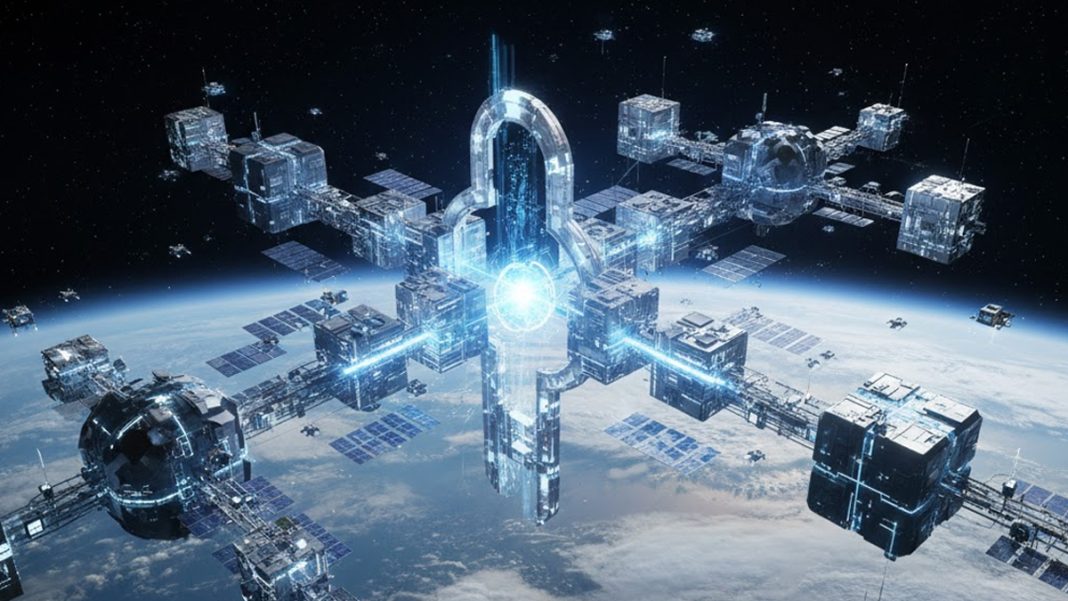
Space is getting crowded fast, and artificial intelligence is becoming the only practical way to manage the chaos. With more than 50,000 tracked objects in orbit—and millions of untracked debris fragments—the era of human operators manually monitoring satellites and calling maneuvers is ending. AI isn’t just improving space operations in 2026. It’s making some of them possible at all.
The Collision Problem Is Getting Serious
Starlink, OneWeb, and a growing fleet of commercial and government satellites have tripled low Earth orbit congestion over the past few years. Satellite operators now receive more than 1,000 conjunction warnings daily—alerts that two objects may come dangerously close to each other. No human team can evaluate that volume in time to respond meaningfully. Autonomous systems have to handle most of it.
AI-powered collision avoidance is doing exactly that. Modern systems can execute maneuvers without waiting for ground intervention, and machine learning algorithms optimize fuel consumption across the maneuver decisions—critical because fuel determines satellite lifespan. Getting the math right on a collision avoidance burn isn’t just about safety. It’s about not wasting the propellant you’ll need for the next thousand warnings.
The financial stakes clarify why this matters commercially. Satellite operators currently face roughly $10 billion annually in collision insurance premiums. AI-driven predictive maneuvers are reducing those premiums by around 40% for operators with sophisticated systems, creating direct ROI from space situational awareness investment.
What the Space Force Is Building
The U.S. Space Force’s Space Domain Awareness Tactical Awareness Program Lab—SDA TAP Lab—represents the military edge of this work. The program deploys AI systems capable of identifying launch histories, sensor signatures, and jamming frequencies of unknown orbital objects. That last capability matters enormously: distinguishing a malfunctioning satellite from one being deliberately maneuvered adversarially requires pattern recognition across massive datasets that no human analyst team could process in real time.
The system fuses data from ground-based radars, optical telescopes, and space-based sensors through neural networks that accelerate object detection tenfold compared to traditional methods. A technique called Local Interpretable Model-agnostic Explanations (LIME) provides explainable AI for orbital tracking—meaning analysts can understand why the system flagged a particular object, not just that it did. For military applications where decisions may have significant consequences, explainability isn’t optional.
Planetary Systems’ AI tools, part of Cohort 5 of the TAP Lab program, provide Space Force Guardians with operational context that civilian collision notifications lack. Knowing that two objects will pass within a certain distance is useful. Knowing that one of them has a history of unusual maneuvers, operates on frequencies associated with electronic warfare, and belongs to a nation currently engaged in orbital denial operations is a different category of information entirely.
Cohort 6 is pushing toward multi-terabyte data pipelines and refined capabilities for distinguishing cooperative from adversarial maneuvers. The underlying concern driving this work is Kessler syndrome—the theoretical cascade where a collision generates debris that causes more collisions, generating more debris, until certain orbital shells become unusable. AI-driven SDA is one of the primary tools for preventing that scenario.
Computing From Orbit
The other major AI development in space isn’t about tracking objects—it’s about processing data where it’s generated. Orbital data centers are moving from concept to prototype in 2026.
The physics drives the logic. Ionospheric propagation delays make the round-trip latency between a LEO satellite and a ground data center unacceptable for real-time applications. A reconnaissance satellite that has to send raw imagery to the ground, wait for processing, and receive instructions back has a fundamental responsiveness problem. An orbital micro-data center that processes the imagery onboard and acts on the results immediately doesn’t.
Blue Origin and Astra are deploying 2026 prototypes featuring liquid-cooled GPU clusters designed for orbital thermal environments—a non-trivial engineering challenge when you can’t rely on convection cooling in a vacuum. Nvidia’s orbital inference chips are enabling sovereign AI model deployment in space, which addresses a data sovereignty issue that’s becoming increasingly significant: nations and organizations that want AI processing of sensitive data without routing it through terrestrial infrastructure controlled by foreign entities.
The applications span military and commercial domains. Defense reconnaissance is the obvious military use case. On the commercial side, LEO micro-data centers are handling 5G backhaul processing and IoT data aggregation for applications where ground-based processing introduces unacceptable latency—maritime communications, remote infrastructure monitoring, precision agriculture using satellite imagery.
India’s Growing Role
The India AI Impact Summit has spotlighted space domain awareness as a priority alongside the country’s broader AI ambitions. ISRO and DRDO are showcasing machine learning applications for orbital tracking, jamming countermeasures, and autonomous surveillance—capabilities that position India as a serious player in Asia-Pacific space situational awareness.
DRDO’s DSP Anupam Sharma has been detailing AI-powered satellite security applications, while ISRO’s Rajiv Chetwani is presenting orbital analytics capabilities developed domestically. The framing connects to India’s broader positioning at the AI Impact Summit: not as a consumer of technology developed elsewhere, but as a contributor to global technical capabilities with its own sovereign stack.
The geopolitical dimension is real. As U.S.-China tensions extend into the space domain, India’s neutral positioning—participating in international space situational awareness cooperation without full alignment with either major power—creates diplomatic value alongside technical contribution.
The Competitive and Budget Landscape
North America currently leads in real-time orbital analytics, but Europe is developing coordinated multi-state space situational awareness infrastructure emphasizing traffic management frameworks. The difference in emphasis reflects different threat perceptions and institutional structures: the U.S. approach is heavily military-integrated, while European frameworks prioritize civilian traffic management and international coordination.
Commercial operators face a tension that isn’t fully resolved. The most sophisticated SDA tools are military systems not available to civilian operators. Commercial satellite companies running large constellations—SpaceX with Starlink, OneWeb, eventually Amazon’s Kuiper—are developing proprietary SSA capabilities because they can’t rely on military data sharing for their operational decisions. That bifurcation creates redundancy and potentially coordination problems.
The SDA TAP Lab faces Congressional funding uncertainty for Cohort expansion, a recurring challenge for specialized military AI programs that don’t fit neatly into traditional procurement categories. The commercial sector’s demand for accessible tools is pushing in the direction of some data sharing, but the classification boundaries that protect the most sensitive military capabilities make full openness impossible.
What’s Coming
The AMOS 2026 conference is positioned as the year’s primary showcase for SDA and space domain awareness breakthroughs. BAE Systems is predicting AI-enhanced operations across space and cyber domains by year-end—a convergence that reflects how thoroughly these domains are becoming interdependent.
The longer-term trajectory is toward what researchers describe as treating space as a computational substrate rather than just a transportation layer. Autonomous constellations that self-organize their coverage patterns, orbital data centers that process information at the edge, and AI systems that maintain situational awareness across 100,000-plus objects continuously—these aren’t science fiction projections. They’re the logical extension of systems being deployed and tested right now.
The transition from space as a place where humans send objects to space as an environment where AI systems operate largely autonomously is already underway. The 2026 inflection point isn’t a prediction. It’s an observation of what’s already happening in orbit.